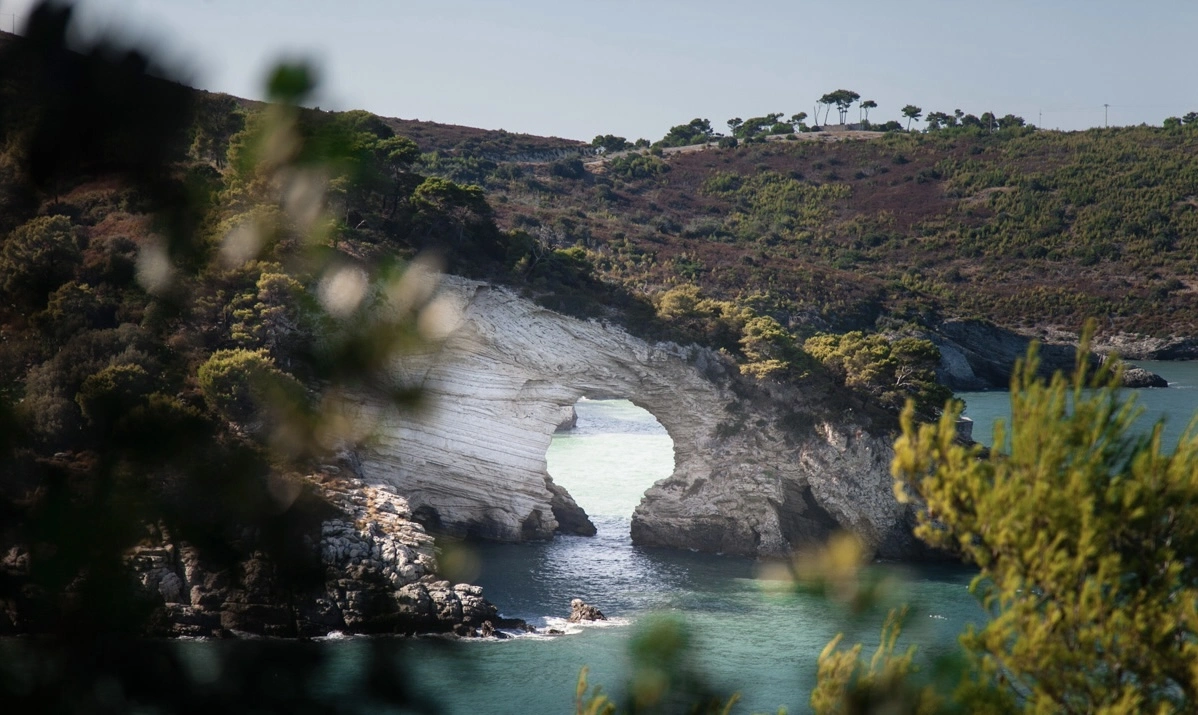
Driving the SS89 coastal road from Manfredonia to Vieste is already one of the most beautiful drives in Italy. But what you see through the windscreen is only the façade. Behind every headland, beneath every cliff, there are caves with no name on any map, coves reachable only by swimming from a boat, rock arches carved by millennia of patient sea. This coast is only truly understood from the water — looking toward the land instead of out to sea.
A boat trip in the Gargano is not a tourist attraction. It's the most honest way to understand where you are. The white limestone cliffs you see from the hairpin bends above become, from the sea, something completely different: taller, more vertical, quieter. The engine cuts out, the boat stops at the entrance to a cave, and you realise this place existed long before any road did.
What you see that you can't see from land
The Gargano coast is one of the most jagged in Italy. Centuries of marine erosion have carved into the limestone a system of caves, tunnels, arches and inlets that make for a seascape and surface landscape unique in the Mediterranean. Some formations are well known — the Grotta del Soffio near Vieste, the Grotta delle Rondinelle north of Peschici, the Arco di San Felice. Others don't even have a name: they're known only to the boatmen who've been taking their children there for decades.
The most beautiful coves in the Gargano have no road access. Not because they're off-limits — simply because there's no road, no path, no way down without climbing bare-handed. Cala Acquaviva, certain beaches between Mattinata and Pugnochiuso, some inlets between Peschici and the northern cape — reached only by boat, and when you get there, you're often alone. The swell gently lifting the hull, the sound of water inside the cave, the emerald green of the white limestone seabed. You don't forget it.
Three options: how to choose
There are three ways to do a boat trip in the Gargano, with very different characteristics and costs. The choice depends on how much freedom you want, how many people you are, and how comfortable you are on open water.
Organised group excursion
The simplest and cheapest option. From the harbours of Vieste, Peschici or Mattinata, group boat trips depart daily in summer — typically on gozzi or boats for 10–20 people — following fixed routes along the coast. Duration is 2–3 hours, cost around €20–30 per person. No booking needed in high season: just show up at the harbour in the morning and get on. The advantage is you need no sailing knowledge, the boatman knows every corner of the coast, and if the sea is rough he decides whether to go or wait. The downside is that you're in a group, stop times are fixed, and the most remote coves get skipped if they take too long to reach.
Dinghy hire without a licence
The option preferred by our guests at Casa e Bottega when they want total freedom. A dinghy with an engine up to 40 HP requires no boating licence and can be hired by the day at the main Gargano harbours. Prices range from €80 to €150 per day depending on season and engine size — split between 4–6 people it becomes very good value. The hire operator explains the controls in ten minutes, gives you a coastal map showing points of interest and areas to avoid, and then you're free. You can stop wherever you want, for as long as you want, come back whenever you want. You can anchor in front of a deserted cove and spend two hours there with no one telling you it's time to leave.
A few things to know before hiring a dinghy: don't approach cliffs in choppy water — reflected currents can push the boat against the rock even with small waves. Keep an eye on fuel — you get a full tank but marine fuel stops aren't everywhere. Respect the marked bathing zones: in summer the Coast Guard patrols them. And bring plenty of water — on a boat under the sun you dehydrate faster than on the beach.
Private gozzo with a local boatman
The best option if you're in a group and want the maximum. A local fisherman with his gozzo takes you wherever you want, explains every cave and cliff, adjusts the route based on sea conditions and the season. This isn't a tour guide — it's a fisherman showing you the Gargano he knows. Prices for a full day range from €250 to €400 for the boat, to be split in the group. Book a few days in advance: the best boatmen fill up fast in summer. In Manfredonia, ask at the Pescheria harbour — you'll find local fishermen who also run excursions in summer.
Where to depart: the four Gargano harbours
Manfredonia is the ideal starting point for guests staying at Casa e Bottega. From Manfredonia harbour you easily reach the coast between Siponto and Mattinata — the white limestone coves of the southern Gargano, the Mattinata cliffs, the Baia delle Zagare from below. It's a less famous coast than the northern stretch but often more authentic: fewer mass-market hire operations, more local boatmen, lower prices.
Vieste is the most organised port for excursions. Dozens of group trips depart daily for the Grotta del Soffio, Grotta Sfondata, Grotta dei Contrabbandieri and Baia di Vignanotica. The right choice for maximum services and maximum flexibility. Vieste is the most convenient and most touristically developed harbour — pros and cons together.
Peschici has a small harbour with excursions to the northern Gargano caves — the Grotta delle Rondinelle, Grotta Campana, Arco di San Felice. Groups are smaller than Vieste and the atmosphere less commercial. If you're visiting Peschici for the day, a boat trip in the afternoon pairs perfectly with lunch at the trabucco.
Mattinata has a small harbour from which you reach some of the least-known, most beautiful coves in the southern Gargano — Cala Acquaviva, Cala degli Olivastri, inlets under limestone cliffs that look like film sets. Fewer organised excursions, better odds of finding a boatman for a private trip at a reasonable price.
What to see from the sea
The Gargano from the sea is above all its caves. Not the illuminated-walkway-with-gift-shop type — Gargano caves are unnamed inlets carved by the sea into limestone, dark inside, low ceilings that make you duck, water coloured dark petroleum green reflecting the light from the entrance. You enter with the engine off, paddling or pushing yourself along the rock walls, and for a few minutes you're completely cut off from the outside world.
The rock arches are the other marvel. Marine erosion has created natural limestone bridges stretching over the sea — the Arco di San Felice near Vieste is the most famous, visible from the road at certain points, but there are dozens of smaller ones along the entire coast. Seen from the water, with the light changing by the hour, they're one of those landscapes that looks faked in photographs: too perfect to be real.
The Tremiti Islands are technically reachable by boat from the Gargano — 40 kilometres of open sea from Manfredonia or Vieste — but those are expeditions for experienced sailors or well-equipped craft. The most practical way to visit them remains the ferry from Manfredonia or Vieste harbour.
The Gargano sea: what to expect
The Gargano sea is not always flat. The local wind — called "tramontana" or "maestrale" depending on direction — can pick up quickly after midday and turn a glassy morning into an hour of short, choppy waves. Not dangerous in absolute terms, but on a small dinghy it makes the return tiring and wet. The practical rule: leave early in the morning, explore the coves in the first hours of the day, be back at harbour before 2pm. In June, the morning sea is almost always a mirror.
For anyone unsure about swimming, when to swim in the Gargano is a common question: from June to September the water is between 22 and 26°C and the coves have white pebble or fine sand floors. Currents in enclosed coves are almost non-existent. The issue isn't cold water but sun — the light bouncing off the water and the white cliffs is intense even on overcast days. High-factor sun cream is the only absolute rule.
When to go: the boating calendar
The best time for a boat trip in the Gargano is June and September. In June the sea is already warm, hire operators are open, prices are 30–40% lower than August and the best spots are often empty. September has the same conditions as June but with the warmest sea of the year — water in September is still 24–25°C after three months of summer sun.
July and August are perfect weather-wise but have two drawbacks: prices rise significantly and the most famous coves — especially near Vieste — fill with boats. The deserted cove you found in June has five dinghies anchored in it in August. Not a disaster, but different.
Frequently asked questions
Do you need a boating licence to hire a dinghy in the Gargano?
For engines up to 40 HP no boating licence is required. Most hire operations offer 25–40 HP dinghies perfect for exploring the coast: powerful enough for the currents, within the no-licence limit.
How much does a boat trip in the Gargano cost?
Organised group excursions cost €20–30 per person for 2–3 hours. Dinghy hire without a licence ranges from €80 to €150 per day depending on season and engine size. A private gozzo with a boatman for a full day costs €250–400, to split between the group.
Where do boat trips in the Gargano depart from?
The main departure points are Manfredonia harbour (southern coast and Gulf), Vieste (caves between Vieste and Pugnochiuso), Peschici (northern caves) and Mattinata (southern Gargano coves).
When is the best time for a boat trip in the Gargano?
The best period is June and September: calm sea, hire operators open, prices 30–40% lower than August and far fewer crowds. July and August are fine but more expensive and busier.
What should you bring on a boat trip in the Gargano?
SPF 50 sun cream, polarised sunglasses, non-slip shoes, plenty of water, a snorkel, a dry change in a waterproof bag, and food if the trip lasts more than three hours. Life jackets are provided by the hire operator.